I get how tempting it is to just mass-order everything from Amazon.
Where I live, I can get a ridiculous amount of stuff delivered the same day. And you might assume that because I’m a designer, I love spending my time wandering through stores looking for beautiful things.
That could not be further from the truth.
My preferred method of shopping would be sitting outside at my farm, drinking coffee, shooing the chickens and clicking Order Now from my comfortable chair.
We live in a post-Covid world where nearly every store has figured out how to bring the store to us. It is wonderfully convenient.
And Lord knows, I still order plenty online.
But sometimes you need to physically leave your own space to find fresh inspiration for it.
Go Places That Aren’t Selling You a Living Room
And I don’t just mean go shopping for home decor.
Go places.
Walk through boutiques. Hotel lobbies. Old downtown shops. Bakeries. Cafés. Restaurants. Historic buildings. Garden centers. Galleries.
Pay attention to what catches your eye.
More importantly, pay attention to how a space makes you feel.
Take pictures. Take notes. Notice the things you keep noticing.
Maybe you keep taking pictures of old brick walls. Maybe it’s oversized artwork, warm wood, unusual lighting or rooms filled with books. You may not even realize you’re doing it at first.
But look through enough pictures and eventually you’ll start to see a pattern.
And those pictures are going to give you a much better starting point for creating an authentic space than sitting at home scrolling through hundreds of products on Amazon.
Because now you aren’t asking Amazon to show you what you like.
You already know.
Inspiration Is Everywhere
Recently I took my 12-year-old son out to run errands with me. My son hates being dragged through stores about as much as you would expect from a 12-year-old boy.
But as we walked into a Reformation clothing boutique, he looked around and said:
“Wow! I want to live in here.”
My son is an outdoorsy, young-Viking kind of boy. The last place I’d expect to discover his style is a women’s boutique, so naturally my ears perked up.
“Oh yeah? What do you like about it?”
And he started pointing.
The plants cascading from above.
The weathered brick disappearing into plaster.
The industrial concrete floor.
The beveled windows with black metal frames.
Suddenly I wasn’t looking at a clothing store anymore. I was looking at the beginnings of his bedroom.
Add some wood and worn brown leather—two other things I already knew he loved—and there it was.
His room.
We snapped a few pictures and kept going.
Later when we got home, we uploaded those images, along with a few others we had saved for his room and a photo of his actual bedroom, and asked AI to put the pieces together.
He took one look at it and smiled. “Yes!”
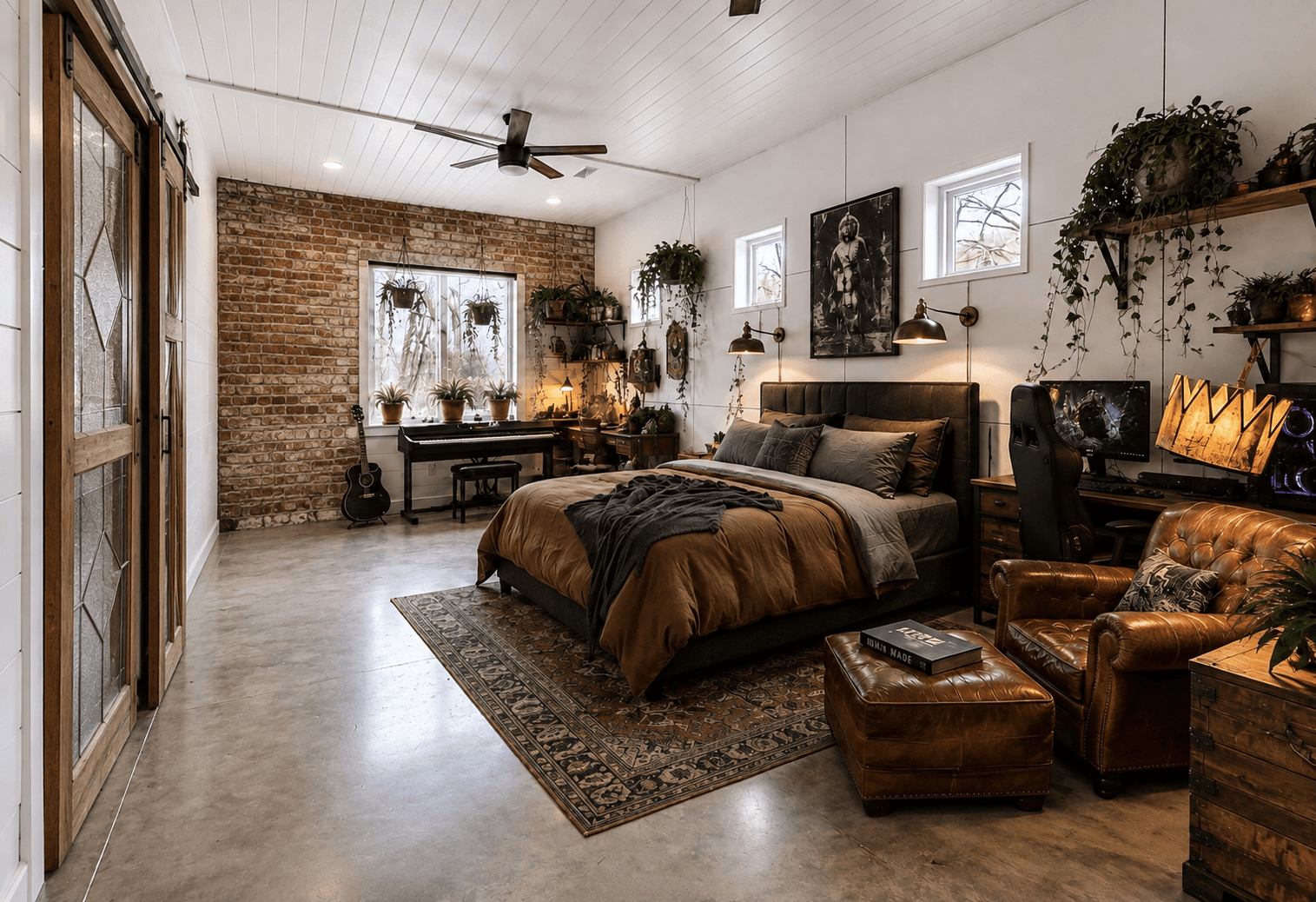
While the final room won’t look exactly like this, we now have a solid point of reference to work from rather than blindly buying pieces and hoping they somehow create a finished room that he loves.
And that is how you begin developing an eye for a space.
You aren’t necessarily looking for a room to copy. You’re collecting clues.
So Why Does a House Full of Amazon Still Look Like Amazon?
Here’s the interesting part.
You could order 50 pieces from 50 completely different sellers on Amazon and still end up with a room that somehow looks like it all came from Amazon.
Why?
Because mass-market shopping tends to give you things from the same design moment.
The furniture may technically come from different manufacturers, but much of it is responding to the same trends, the same search terms and the same things people are currently buying.
The finishes are similar.
The proportions are similar.
The distressing is similar.
The colors are similar.
Even the things designed to look old tend to look old in exactly the same way.
And that last one is a dead giveaway.
Real rooms accumulate contradiction.
Something is older than everything else. Something is slightly too large. Something has faded. Something was handmade. Something came from a completely different decade. Something has a scratch nobody bothered to repair.
There are pieces that don’t have perfect companions.
That little bit of friction is what makes a room interesting.
When everything was manufactured recently, purchased at roughly the same time and selected through the same algorithm, you can choose 100 different products and still end up with one very recognizable visual language.
The room isn’t necessarily ugly.
It just doesn’t have a story yet.
You Need Things the Algorithm Would Never Put Together
This is where thrift stores, antique shops, flea markets, estate sales, Facebook Marketplace and weird little shops become incredibly useful.
Not because everything in your STR needs to be old.
Please don’t do that either.
The goal isn’t to replace an Amazon showroom with an antique mall.
The goal is to introduce things that weren’t designed to coordinate.
Buy the sofa online.
Find the old side table somewhere else.
Order the sheets.
Bring home the strange painting.
Buy six matching dining chairs if you need six sturdy matching dining chairs. Then put an old wooden bowl in the middle of the table that looks like it has seen several generations.
Mix new things with old things.
Expensive things with inexpensive things.
Polished things with weathered things.
Simple things with the occasional thing that makes somebody stop and look twice.
That’s what collected actually means.
It isn’t clutter.
It isn’t filling every available surface with antiques.
And it definitely isn’t making an STR so precious that you’re afraid to actually host guests in it.
It’s giving the room enough variation that it feels as though it came together over time—even if you actually had six weeks and a launch date.
Use Amazon for What Amazon Is Brilliant At
There are plenty of things I would happily order online for an STR.
Sheets. Towels. Mattress protectors. Kitchen basics. Curtain rods. Replacement glassware. Storage containers. Lamps when I find the right one. Practical furniture when budget, durability or timing makes it the best choice. And especially items that are prone to needing to be replaced often—especially when we are talking short-term rentals.
Convenience is not the enemy of good design.
Sameness is.
So don’t make yourself unnecessarily miserable trying to source every toss pillow from a charming little antique shop three towns over.
Use Amazon.
Use Target.
Use IKEA.
Use HomeGoods.
Use whatever makes sense.
Just don’t let one retailer—or one algorithm—make every design decision for you.
Give Yourself Permission to Wander
Some of the best design research doesn’t look like design research at all.
Go have coffee somewhere beautiful.
Walk through the old hotel downtown.
Step inside the boutique even if you have absolutely no intention of buying the clothes.
Notice the floor.
Notice the lighting.
Notice what they did with the walls.
Notice the combination you never would have thought to search for online because you didn’t know you liked it yet.
That’s the limitation of shopping entirely from a screen.
The internet is exceptionally good at helping you find what you already know to ask for.
Real places introduce you to things you didn’t know to search for.
And those discoveries are often the difference between a room that looks purchased and one that looks collected.
So yes, order the mattress protectors from your back porch.
I’ll probably be doing the same thing.
But every once in a while, go on an adventure and go see what you can find.
Continue Reading
Start With the One Thing You Love
Mix Your Design Styles
How to Use AI to Create the Perfect Color Palette in Seconds
I get how tempting it is to just mass-order everything from Amazon.
Where I live, I can get a ridiculous amount of stuff delivered the same day. And you might assume that because I’m a designer, I love spending my time wandering through stores looking for beautiful things.
That could not be further from the truth.
My preferred method of shopping would be sitting outside at my farm, drinking coffee, shooing the chickens and clicking Order Now from my comfortable chair.
We live in a post-Covid world where nearly every store has figured out how to bring the store to us. It is wonderfully convenient.
And Lord knows, I still order plenty online.
But sometimes you need to physically leave your own space to find fresh inspiration for it.
Go Places That Aren’t Selling You a Living Room
And I don’t just mean go shopping for home decor.
Go places.
Walk through boutiques. Hotel lobbies. Old downtown shops. Bakeries. Cafés. Restaurants. Historic buildings. Garden centers. Galleries.
Pay attention to what catches your eye.
More importantly, pay attention to how a space makes you feel.
Take pictures. Take notes. Notice the things you keep noticing.
Maybe you keep taking pictures of old brick walls. Maybe it’s oversized artwork, warm wood, unusual lighting or rooms filled with books. You may not even realize you’re doing it at first.
But look through enough pictures and eventually you’ll start to see a pattern.
And those pictures are going to give you a much better starting point for creating an authentic space than sitting at home scrolling through hundreds of products on Amazon.
Because now you aren’t asking Amazon to show you what you like.
You already know.
Inspiration Is Everywhere
Recently I took my 12-year-old son out to run errands with me. My son hates being dragged through stores about as much as you would expect from a 12-year-old boy.
But as we walked into a Reformation clothing boutique, he looked around and said:
“Wow! I want to live in here.”
My son is an outdoorsy, young-Viking kind of boy. The last place I’d expect to discover his style is a women’s boutique, so naturally my ears perked up.
“Oh yeah? What do you like about it?”
And he started pointing.
The plants cascading from above.
The weathered brick disappearing into plaster.
The industrial concrete floor.
The beveled windows with black metal frames.
Suddenly I wasn’t looking at a clothing store anymore. I was looking at the beginnings of his bedroom.
Add some wood and worn brown leather—two other things I already knew he loved—and there it was.
His room.
We snapped a few pictures and kept going.
Later when we got home, we uploaded those images, along with a few others we had saved for his room and a photo of his actual bedroom, and asked AI to put the pieces together.
He took one look at it and smiled. “Yes!”
While the final room won’t look exactly like this, we now have a solid point of reference to work from rather than blindly buying pieces and hoping they somehow create a finished room that he loves.
And that is how you begin developing an eye for a space.
You aren’t necessarily looking for a room to copy. You’re collecting clues.
So Why Does a House Full of Amazon Still Look Like Amazon?
Here’s the interesting part.
You could order 50 pieces from 50 completely different sellers on Amazon and still end up with a room that somehow looks like it all came from Amazon.
Why?
Because mass-market shopping tends to give you things from the same design moment.
The furniture may technically come from different manufacturers, but much of it is responding to the same trends, the same search terms and the same things people are currently buying.
The finishes are similar.
The proportions are similar.
The distressing is similar.
The colors are similar.
Even the things designed to look old tend to look old in exactly the same way.
And that last one is a dead giveaway.
Real rooms accumulate contradiction.
Something is older than everything else. Something is slightly too large. Something has faded. Something was handmade. Something came from a completely different decade. Something has a scratch nobody bothered to repair.
There are pieces that don’t have perfect companions.
That little bit of friction is what makes a room interesting.
When everything was manufactured recently, purchased at roughly the same time and selected through the same algorithm, you can choose 100 different products and still end up with one very recognizable visual language.
The room isn’t necessarily ugly.
It just doesn’t have a story yet.
You Need Things the Algorithm Would Never Put Together
This is where thrift stores, antique shops, flea markets, estate sales, Facebook Marketplace and weird little shops become incredibly useful.
Not because everything in your STR needs to be old.
Please don’t do that either.
The goal isn’t to replace an Amazon showroom with an antique mall.
The goal is to introduce things that weren’t designed to coordinate.
Buy the sofa online.
Find the old side table somewhere else.
Order the sheets.
Bring home the strange painting.
Buy six matching dining chairs if you need six sturdy matching dining chairs. Then put an old wooden bowl in the middle of the table that looks like it has seen several generations.
Mix new things with old things.
Expensive things with inexpensive things.
Polished things with weathered things.
Simple things with the occasional thing that makes somebody stop and look twice.
That’s what collected actually means.
It isn’t clutter.
It isn’t filling every available surface with antiques.
And it definitely isn’t making an STR so precious that you’re afraid to actually host guests in it.
It’s giving the room enough variation that it feels as though it came together over time—even if you actually had six weeks and a launch date.
Use Amazon for What Amazon Is Brilliant At
There are plenty of things I would happily order online for an STR.
Sheets. Towels. Mattress protectors. Kitchen basics. Curtain rods. Replacement glassware. Storage containers. Lamps when I find the right one. Practical furniture when budget, durability or timing makes it the best choice. And especially items that are prone to needing to be replaced often—especially when we are talking short-term rentals.
Convenience is not the enemy of good design.
Sameness is.
So don’t make yourself unnecessarily miserable trying to source every toss pillow from a charming little antique shop three towns over.
Use Amazon.
Use Target.
Use IKEA.
Use HomeGoods.
Use whatever makes sense.
Just don’t let one retailer—or one algorithm—make every design decision for you.
Give Yourself Permission to Wander
Some of the best design research doesn’t look like design research at all.
Go have coffee somewhere beautiful.
Walk through the old hotel downtown.
Step inside the boutique even if you have absolutely no intention of buying the clothes.
Notice the floor.
Notice the lighting.
Notice what they did with the walls.
Notice the combination you never would have thought to search for online because you didn’t know you liked it yet.
That’s the limitation of shopping entirely from a screen.
The internet is exceptionally good at helping you find what you already know to ask for.
Real places introduce you to things you didn’t know to search for.
And those discoveries are often the difference between a room that looks purchased and one that looks collected.
So yes, order the mattress protectors from your back porch.
I’ll probably be doing the same thing.
But every once in a while, go on an adventure and go see what you can find.
Continue Reading
Start With the One Thing You Love
Mix Your Design Styles
How to Use AI to Create the Perfect Color Palette in Seconds