Start With the One Thing You Love
You know when you’ve found the thing.
You don’t even always know why that thing is the thing. You just know that it is.
Maybe it’s a rug in a pattern or color palette that surprised you because you never expected to be drawn to it. Maybe it’s something sentimental that’s been passed down in your family. A piece of art. An armchair. An old dresser. Something you found at a flea market and absolutely did not need, but knew immediately was coming home with you.
It could be anything.
But out of everything you’ve looked at or considered for that space, it’s the one piece you keep coming back to.
Pay attention to that.
Because if you’re struggling to know where to start when designing a room, start with that one thing you love.
You don’t need to know what the whole room looks like yet. You don’t need a perfectly defined style, a Pinterest board with 400 saved photos, or every paint color and piece of furniture already chosen.
You just need somewhere to begin.
And the thing is a very good place to start.
Sometimes You Find It Before You Know You Need It
I am a sucker for folk art.
Recently, I was out shopping for a client when I found this ridiculous antique folk bird carved out of wood. It was old. It was broken. And honestly, its face looked a little more like the Loch Ness monster than a bird.
I loved it.
I did not buy it.
I left, went on with my life and proceeded to think about that ridiculous bird for weeks.
Eventually I went back for it.
Why?
I have no idea. It just made me happy.
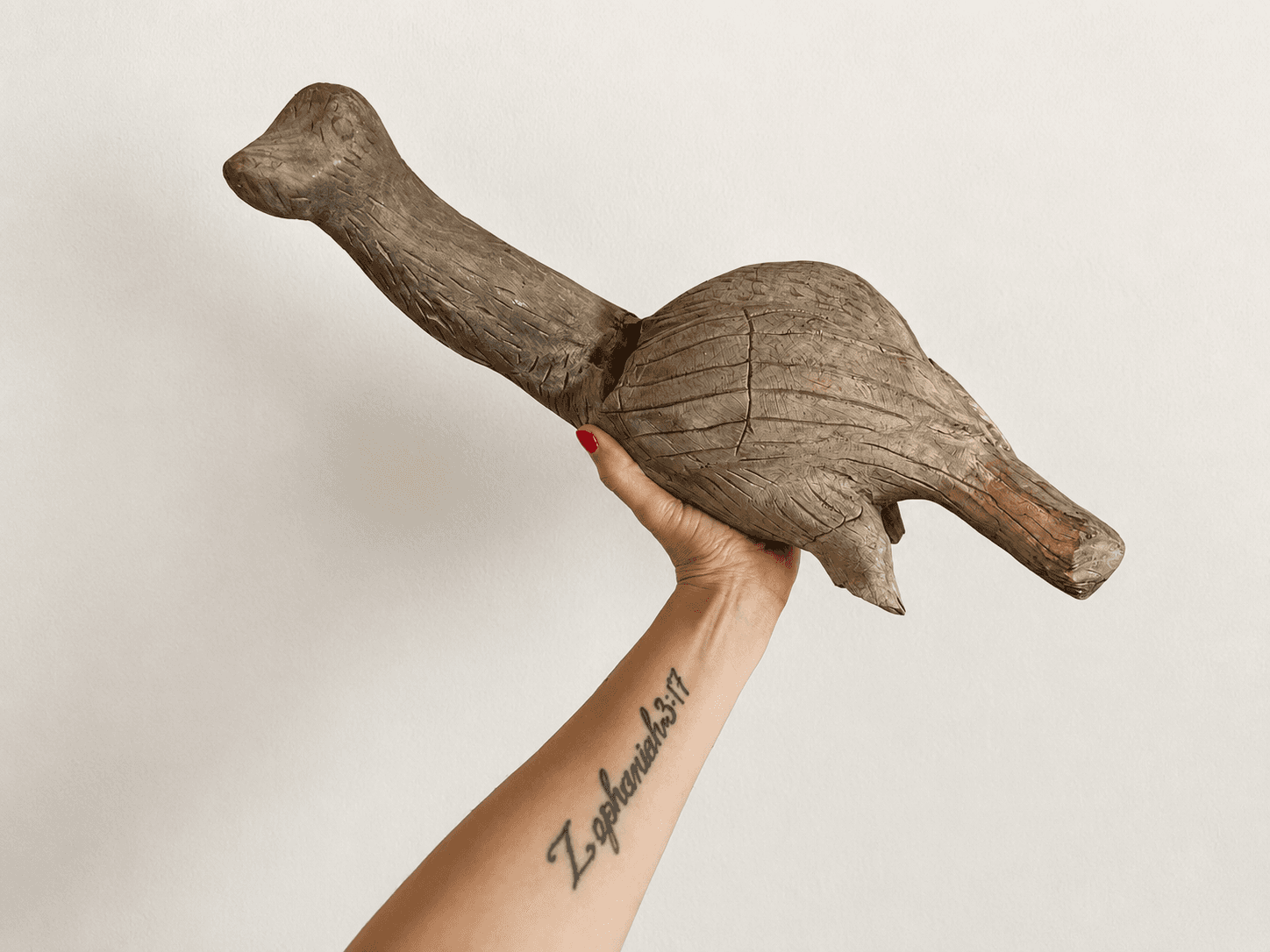
The antique folk bird that looked enough like the Loch Ness monster that I left it behind—and loved enough that I eventually went back for it.
The funny thing is, I had a little vintage desk corner at home that I hadn’t started working on yet. I knew I wanted to do something with it, but I wasn’t quite sure where to start.
Turns out, the Loch Ness bird was exactly what it needed.
And once I put him there, I had a direction.
That’s the thing about finding something you really love. It doesn’t always happen when you’ve decided it’s time to design a room. Sometimes you’re not looking for anything at all. Sometimes you’re shopping for someone else.
And sometimes you buy a broken wooden bird for reasons you cannot adequately explain.
You don’t always know when the right piece is going to come along.
But when something keeps tugging at you, it may be worth paying attention.
Let It Give You a Direction
Once you have it, look at what you love about it.
If it’s a rug, maybe it’s the colors. Maybe it’s the pattern. Maybe it has a worn, collected look that immediately makes everything brand new feel a little too new beside it.
If it’s an old wooden dresser, maybe it’s the warmth of the wood, the age, the imperfect finish or the brass hardware.
If it’s a piece of art, look at the colors, the mood and the contrast. There may be an entire room hiding inside it.
You don’t have to copy every element of the piece. You’re looking for clues.
Those clues give you somewhere to go next.
For my little desk corner, the bird immediately changed what made sense around it. Something too polished or modern would have felt wrong. I already had this odd, imperfect old thing I loved, so I could let the rest of the space develop from there.
That’s much easier than starting with an empty corner and several thousand possible directions.
Don’t Match It. Build Around It.
This is where it’s easy to go a little too far.
You find a beautiful blue-and-cream rug, so you buy blue pillows. Then blue curtains. Then a blue vase. Then artwork with precisely the same shade of blue.
Before long, the piece you loved enough to build the room around is no longer particularly interesting. It’s surrounded by a room full of things trying to look just like it.
Maybe you pull one of the quieter colors from the rug for the walls, but bring in a completely different wood tone for warmth. Maybe there’s a little green in the pattern, but instead of searching for green accessories, you bring in a plant or let the view outside carry that color into the room.
Repeat enough to create a connection, then let other things be different.
Rooms need contrast. Old beside new. Smooth beside rough. Dark beside light. Something refined next to something worn.
The piece you started with should still have something to say when the room is finished.
Sometimes You Already Own the Thing
Of course, you don’t always have to stumble across it in an antique store.
Before you go looking for your starting piece, look at what you already have.
We tend to approach a new room by thinking about what we need to buy. But sometimes the thing has been sitting in your house for years.
Maybe it was passed down to you. Maybe you bought it years ago because you loved it, even though you never quite figured out where it belonged.
I love old things, especially pieces with a story attached to them. I would much rather find a way to make something I love work than get rid of it because it doesn’t fit neatly into the style I originally had in mind.
Instead of designing a room and then trying to squeeze that piece into it, let the piece change the plan.
Continue reading: What Would You Keep?
What If It Doesn’t Fit Your Usual Style?
That may be exactly why it’s worth paying attention to.
Sometimes what catches your eye doesn’t fit the style you thought you liked. Maybe you usually choose neutrals and suddenly love a rich color. Maybe you gravitate toward clean lines but find yourself drawn to something old and ornate.
You don’t have to talk yourself out of it because it doesn’t fit the label you’ve given your style.
Most of us aren’t strictly one style anyway. You might love the warmth and age of vintage European interiors, the simplicity of Scandinavian design and a few of the clean lines of mid-century modern.
The goal isn’t to figure out which box you belong in. It’s learning how to bring the things you love together in a way that feels intentional.
Continue reading: You Don’t Have to Pick a Style: How to Mix the Ones You Love
Let the Room Develop From There
Once you have a starting point, you don’t need to make every other decision at once.
You have context now.
You can look at a sofa and ask whether it works with what you’ve already chosen. You can compare paint colors against something real instead of trying to imagine an entire room from a tiny square on a paint card. You can tell when another pattern adds something and when it’s simply too much.
Each choice narrows the possibilities for the next.
That’s a much easier way to design than trying to solve an entire room in one shopping trip.
It also leaves room for another unexpected piece to come along.
I think that’s part of what makes a room feel personal. Not everything was chosen from a plan made before you started. Some things were found along the way.
Know When to Leave It Alone
Not every color, shape or idea in your starting piece needs to appear somewhere else.
If something is already doing its job beautifully, let it.
A bold piece may need quieter things around it. A large piece of artwork may need an empty wall beside it. Something with a lot of texture may look better against something simple.
Negative space is part of designing too.
You don’t have to keep adding things until every corner has been addressed.
Sometimes stopping is the decision that makes everything else work.
Start With Something You Actually Love
There are plenty of ways to design a room. But I’ve found that starting with something I genuinely love tends to lead somewhere much more interesting than starting with what I think I’m supposed to buy.
It doesn’t have to be expensive.
It doesn’t have to be impressive.
It doesn’t even have to make complete sense when you first find it.
Apparently, it doesn’t even have to look convincingly like the animal it was intended to be.
Sometimes it just makes you happy.
That’s enough reason to bring it home.
And you may find that the room you didn’t know how to start suddenly has its beginning.
Continue Reading
What Would You Keep?
You Don’t Have to Pick a Style: How to Mix the Ones You Love
How to Make an STR Look Collected Instead of Shipped In From Amazon
Start With the One Thing You Love
You know when you’ve found the thing.
You don’t even always know why that thing is the thing. You just know that it is.
Maybe it’s a rug in a pattern or color palette that surprised you because you never expected to be drawn to it. Maybe it’s something sentimental that’s been passed down in your family. A piece of art. An armchair. An old dresser. Something you found at a flea market and absolutely did not need, but knew immediately was coming home with you.
It could be anything.
But out of everything you’ve looked at or considered for that space, it’s the one piece you keep coming back to.
Pay attention to that.
Because if you’re struggling to know where to start when designing a room, start with that one thing you love.
You don’t need to know what the whole room looks like yet. You don’t need a perfectly defined style, a Pinterest board with 400 saved photos, or every paint color and piece of furniture already chosen.
You just need somewhere to begin.
And the thing is a very good place to start.
Sometimes You Find It Before You Know You Need It
I am a sucker for folk art.
Recently, I was out shopping for a client when I found this ridiculous antique folk bird carved out of wood. It was old. It was broken. And honestly, its face looked a little more like the Loch Ness monster than a bird.
I loved it.
I did not buy it.
I left, went on with my life and proceeded to think about that ridiculous bird for weeks.
Eventually I went back for it.
Why?
I have no idea. It just made me happy.
The antique folk bird that looked enough like the Loch Ness monster that I left it behind—and loved enough that I eventually went back for it.
The funny thing is, I had a little vintage desk corner at home that I hadn’t started working on yet. I knew I wanted to do something with it, but I wasn’t quite sure where to start.
Turns out, the Loch Ness bird was exactly what it needed.
And once I put him there, I had a direction.
That’s the thing about finding something you really love. It doesn’t always happen when you’ve decided it’s time to design a room. Sometimes you’re not looking for anything at all. Sometimes you’re shopping for someone else.
And sometimes you buy a broken wooden bird for reasons you cannot adequately explain.
You don’t always know when the right piece is going to come along.
But when something keeps tugging at you, it may be worth paying attention.
Let It Give You a Direction
Once you have it, look at what you love about it.
If it’s a rug, maybe it’s the colors. Maybe it’s the pattern. Maybe it has a worn, collected look that immediately makes everything brand new feel a little too new beside it.
If it’s an old wooden dresser, maybe it’s the warmth of the wood, the age, the imperfect finish or the brass hardware.
If it’s a piece of art, look at the colors, the mood and the contrast. There may be an entire room hiding inside it.
You don’t have to copy every element of the piece. You’re looking for clues.
Those clues give you somewhere to go next.
For my little desk corner, the bird immediately changed what made sense around it. Something too polished or modern would have felt wrong. I already had this odd, imperfect old thing I loved, so I could let the rest of the space develop from there.
That’s much easier than starting with an empty corner and several thousand possible directions.
Don’t Match It. Build Around It.
This is where it’s easy to go a little too far.
You find a beautiful blue-and-cream rug, so you buy blue pillows. Then blue curtains. Then a blue vase. Then artwork with precisely the same shade of blue.
Before long, the piece you loved enough to build the room around is no longer particularly interesting. It’s surrounded by a room full of things trying to look just like it.
Maybe you pull one of the quieter colors from the rug for the walls, but bring in a completely different wood tone for warmth. Maybe there’s a little green in the pattern, but instead of searching for green accessories, you bring in a plant or let the view outside carry that color into the room.
Repeat enough to create a connection, then let other things be different.
Rooms need contrast. Old beside new. Smooth beside rough. Dark beside light. Something refined next to something worn.
The piece you started with should still have something to say when the room is finished.
Sometimes You Already Own the Thing
Of course, you don’t always have to stumble across it in an antique store.
Before you go looking for your starting piece, look at what you already have.
We tend to approach a new room by thinking about what we need to buy. But sometimes the thing has been sitting in your house for years.
Maybe it was passed down to you. Maybe you bought it years ago because you loved it, even though you never quite figured out where it belonged.
I love old things, especially pieces with a story attached to them. I would much rather find a way to make something I love work than get rid of it because it doesn’t fit neatly into the style I originally had in mind.
Instead of designing a room and then trying to squeeze that piece into it, let the piece change the plan.
Continue reading: What Would You Keep?
What If It Doesn’t Fit Your Usual Style?
That may be exactly why it’s worth paying attention to.
Sometimes what catches your eye doesn’t fit the style you thought you liked. Maybe you usually choose neutrals and suddenly love a rich color. Maybe you gravitate toward clean lines but find yourself drawn to something old and ornate.
You don’t have to talk yourself out of it because it doesn’t fit the label you’ve given your style.
Most of us aren’t strictly one style anyway. You might love the warmth and age of vintage European interiors, the simplicity of Scandinavian design and a few of the clean lines of mid-century modern.
The goal isn’t to figure out which box you belong in. It’s learning how to bring the things you love together in a way that feels intentional.
Continue reading: You Don’t Have to Pick a Style: How to Mix the Ones You Love
Let the Room Develop From There
Once you have a starting point, you don’t need to make every other decision at once.
You have context now.
You can look at a sofa and ask whether it works with what you’ve already chosen. You can compare paint colors against something real instead of trying to imagine an entire room from a tiny square on a paint card. You can tell when another pattern adds something and when it’s simply too much.
Each choice narrows the possibilities for the next.
That’s a much easier way to design than trying to solve an entire room in one shopping trip.
It also leaves room for another unexpected piece to come along.
I think that’s part of what makes a room feel personal. Not everything was chosen from a plan made before you started. Some things were found along the way.
Know When to Leave It Alone
Not every color, shape or idea in your starting piece needs to appear somewhere else.
If something is already doing its job beautifully, let it.
A bold piece may need quieter things around it. A large piece of artwork may need an empty wall beside it. Something with a lot of texture may look better against something simple.
Negative space is part of designing too.
You don’t have to keep adding things until every corner has been addressed.
Sometimes stopping is the decision that makes everything else work.
Start With Something You Actually Love
There are plenty of ways to design a room. But I’ve found that starting with something I genuinely love tends to lead somewhere much more interesting than starting with what I think I’m supposed to buy.
It doesn’t have to be expensive.
It doesn’t have to be impressive.
It doesn’t even have to make complete sense when you first find it.
Apparently, it doesn’t even have to look convincingly like the animal it was intended to be.
Sometimes it just makes you happy.
That’s enough reason to bring it home.
And you may find that the room you didn’t know how to start suddenly has its beginning.
Continue Reading
What Would You Keep?
You Don’t Have to Pick a Style: How to Mix the Ones You Love
How to Make an STR Look Collected Instead of Shipped In From Amazon